
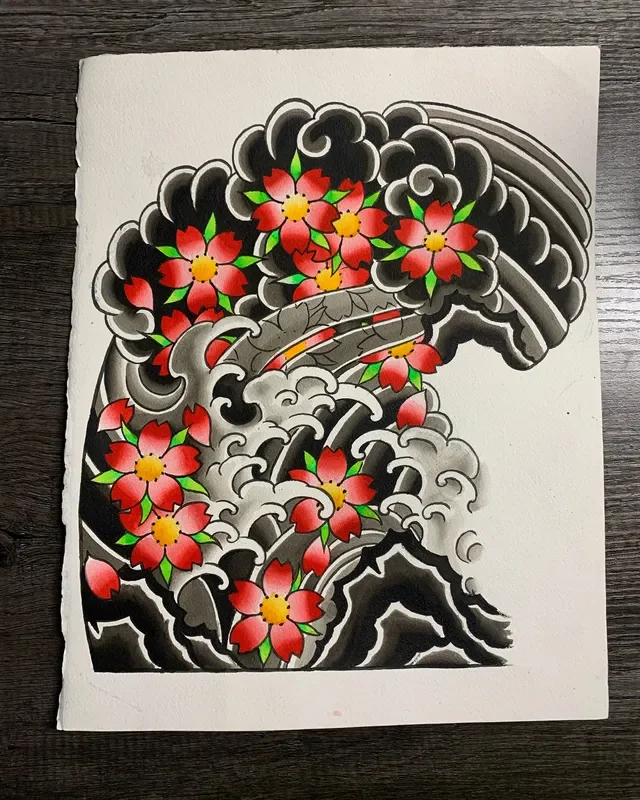
Sakura, Water, and Rock half sleeve painting by Brett Semrick
So in this blog I’ll be covering Suiseki and the element of rocks in Japanese tattooing. Suiseki specifically is a way less common and different thing than the rocks you see in the background of traditional Japanese tattooing, but there is a parallel.
Im doing a flash special for Suiseki designs this week, so I figured it would be a great time to talk about them. Im hoping through writing this blog I can cultivate some awareness of them and help make them something more peolple would consider getting as a tattoo.
I'm a personal fan of rocks in tattooing, whether they're used as a standalone design or as a background element in large-format work.
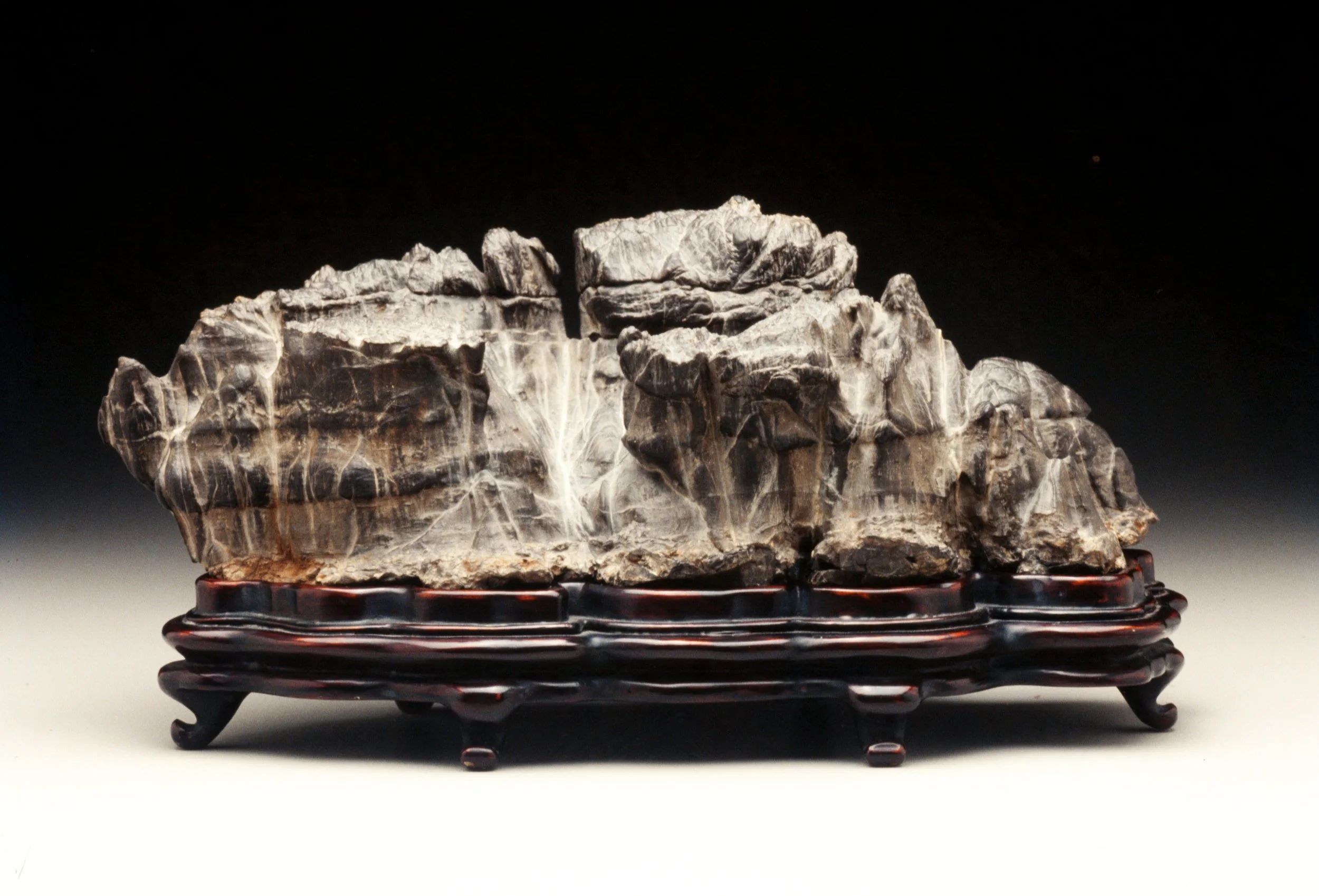
Suiseki on display representing a waterfall that cuts the stone in the center; right of waterfall is a tunnel through cliff face with a cave in the overhang nearby. Photo from rawpixwl.
What are Suiseki?
So I first encountered suiseki a few years ago while living in Tennessee, when I was really starting to get into bonsai.
After becoming a member of the Nashville Bonsai Society attending events and also going down a perpetual wormhole of Youtube videos I discovered Suiseki.
Suiseki (水石) are naturally formed stones that are collected and displayed along with bonsai or by themselves. The stones, like bonsai are representations of nature in miniature. They can be appreciated for their ability to suggest landscapes, mountains, and other naturally occurring phenomena.
Here’s some links to Suiseki video from the WABI Channel. One of my favorites on YouTube:
Introducing Famous Japanese Suiseki Stones
Rocks In Japanese Culture
Rocks hold a significant place in Japanese culture. They can be a place, marker, and a presence, not just an inanimate object.
Iwakura, which are rocks or rock formations held sacred in Shinto, are considered dwelling places where kami (spirits or gods) descend and reside.
Rocks are a common theme in Ukiyo-e prints, represented everywhere, from coastal cliffs being pounded by waves, to various landscapes including river and mountain scenes, and used to provide human scale and perspective.
Rock gardens, known as karesansui (枯山水) or dry landscape gardens, are also very popular and something I check out whenever I have a chance. Originating from Zen Buddhist monks, their minimalist style is also meant to replicate nature in a similar way as bonsai or suiseki.
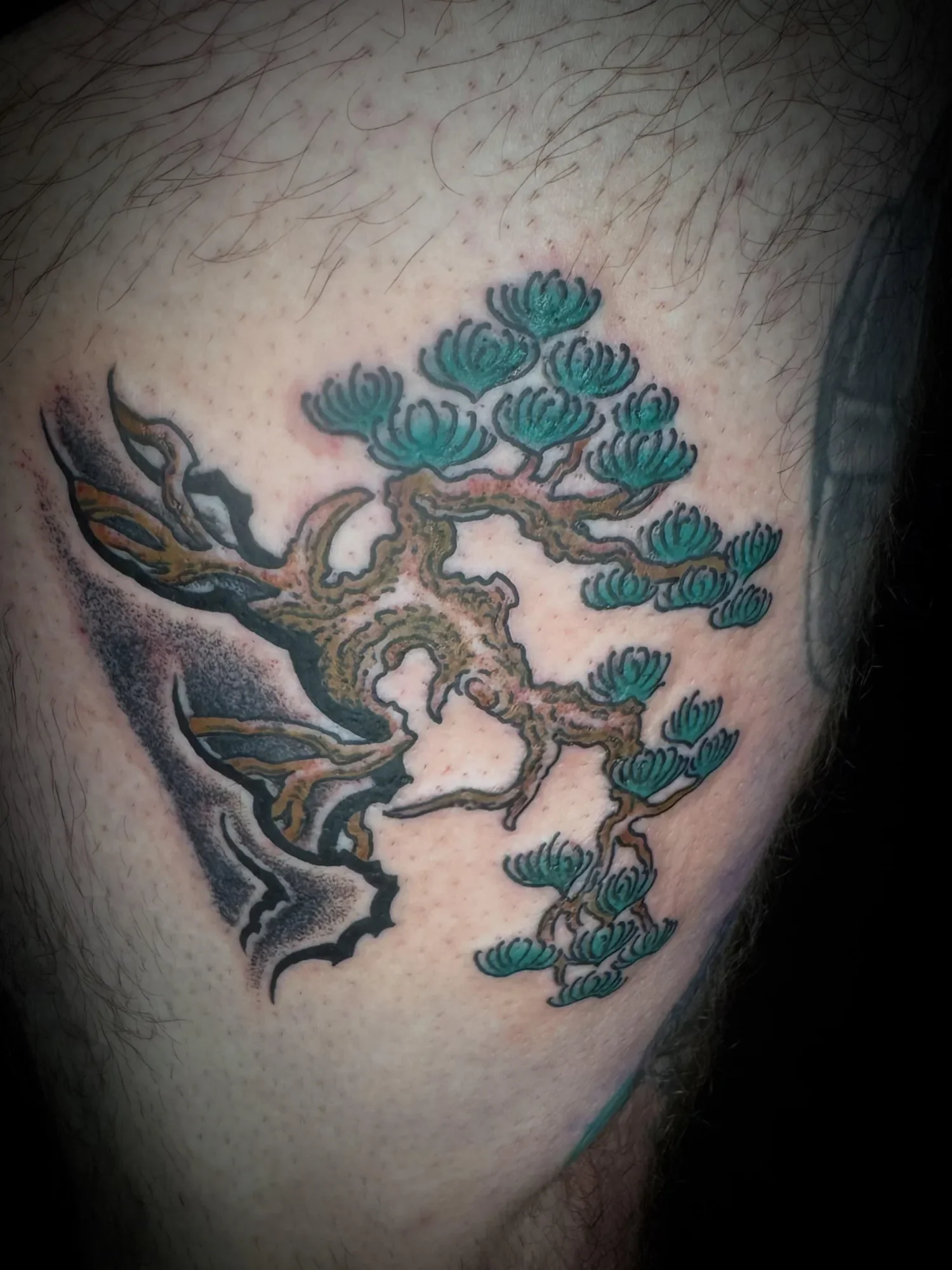
Japanese White Pine(goyomatsu) on rocks tattoo by Brett Semrick
Rocks In Tattooing
The rocks used in traditional Japanese tattooing are part of gakubori (額彫り). They are part of the group of background elements used alongside wind bars, clouds, waves, flowers, maple/ginkgo leaves, flames, and more.
They have many uses in composition. They can break up large areas of background while creating depth. Acting as a separator between foreground and background, they can help establish a horizon line and determine where one element starts and the other begins.
An example would be a waterfall element on the lower portion of a design that uses rocks at the midway point to transition into clouds.
They are also used as a platform for characters that are the main foreground subject to be standing or sitting on. A great example would be one of the deities like Fudō Myōō (Acala) portrayed standing on a rock.
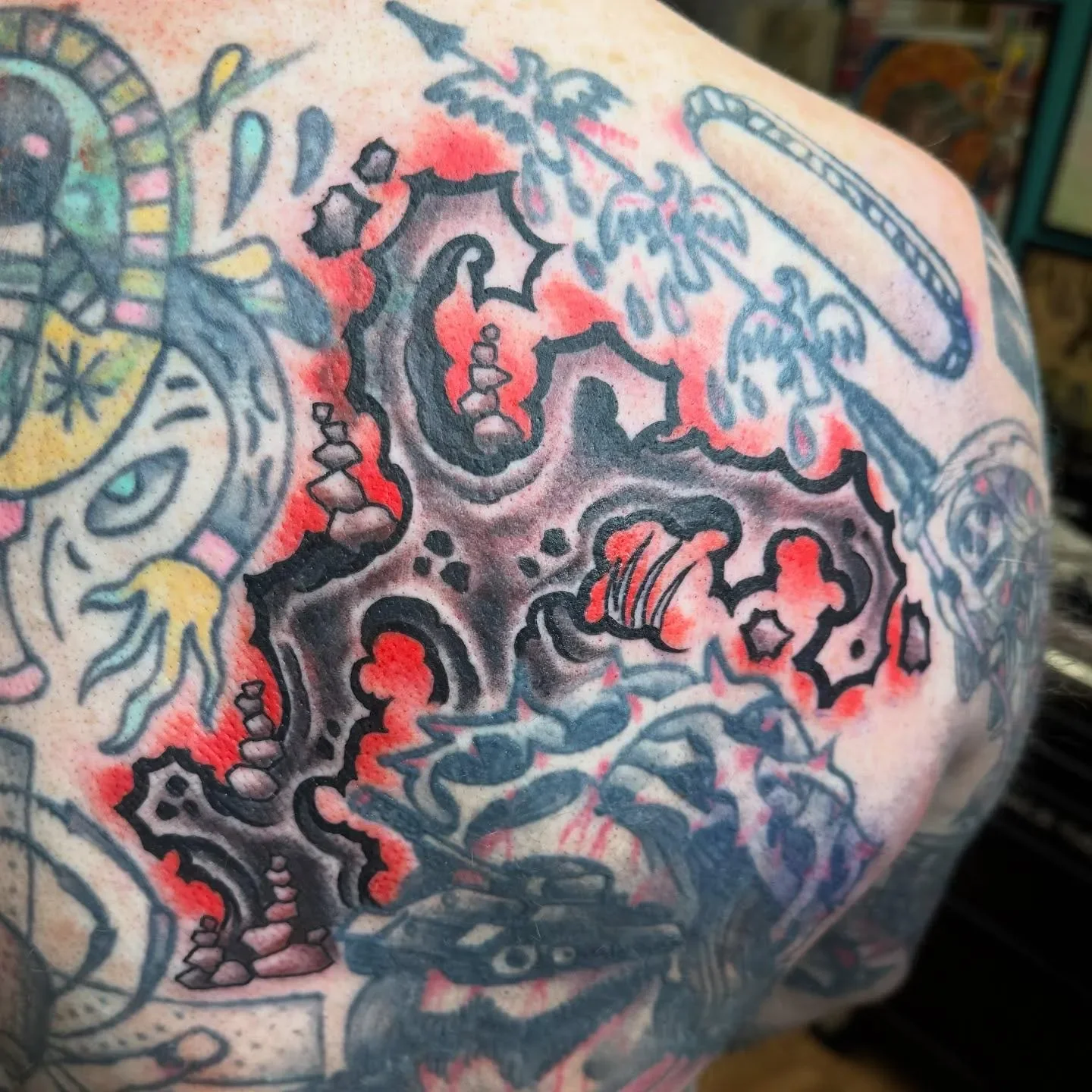
Drawn on rocks used a gap filler between existing tattoos by Brett Semrick
How i use them
Rocks have a multitude of uses in tattooing. I use them for things like framing in a larger composition, but they also work very well as a gap filler for small and oddly shaped spaces.
Due to the nature of how malleable they are as designs, they can be easily manipulated to fit some pretty odd spaces that a lot of other design elements wouldn't work in.
They are capable of looking irregular and intentional at the same time. That same malleability can also be applied to large-format designs.
Rocks are a great thing to use for contrast and texture. The use of grey shading, dotwork/stippling, and various cracks, holes, and crevices can create so many interesting effects.
In Conclusion
If you are still here reading this, I am impressed. I hope someone made it this far because I have really enjoyed writing these things. I also really enjoy working with rocks, both suiseki and gakubori in my tattooing, and hope to start doing more of it.
Suiseki and good tattoos are both something that cannot be made overnight. If you are interested in adding some rock elements to your collection or starting a large composition with rocks used as a background element, feel free to reach out. I would love to hear your ideas.
I will also be doing a Flash Special this week for Friday the 13th at Remington Tattoo Parlor in North Park. The theme will be suiseki and rocks. This will be a great opportunity to come out, see the shop, and chat about your concepts for upcoming tattoos.
FAQ
What is suiseki?
Suiseki (水石) are naturally formed stones that are collected and displayed along with bonsai or by themselves. The stones, like bonsai, are representations of nature in miniature. They can be appreciated for their ability to suggest landscapes, mountains, and other naturally occurring phenomena.
Are rocks just filler in Japanese tattooing?
No. The rocks used in traditional Japanese tattooing are part of gakubori (額彫り). They are part of the group of background elements used alongside wind bars, clouds, waves, flowers, maple/ginkgo leaves, flames, and more.
What do rocks do in a composition?
They have many uses in composition. They can break up large areas of background while creating depth. Acting as a separator between foreground and background, they can help establish a horizon line and determine where one element starts and the other begins.
How do you use rocks in your work?
Rocks have a multitude of uses in tattooing. I use them for things like framing in a larger composition, but they also work very well as a gap filler for small and oddly shaped spaces. Due to the nature of how malleable they are as designs, they can be easily manipulated to fit some pretty odd spaces that a lot of other design elements would not work in. They are capable of looking irregular and intentional at the same time.
What makes rocks good for contrast and texture?
Rocks are a great thing to use for contrast and texture. The use of grey shading, dotwork/stippling, and various cracks, holes, and crevices can create so many interesting effects.
Can I get a suiseki tattoo as a small piece or as part of a larger piece?
Yes. Suiseki and good tattoos are both something that cannot be made overnight. If you are interested in adding some rock elements to your collection or starting a large composition with rocks used as a background element, feel free to reach out. I would love to hear your ideas.
Are you doing suiseki flash?
Yes. I will also be doing a Flash Special this week for Friday the 13th at Remington Tattoo Parlor in North Park. The theme will be suiseki and rocks. This will be a great opportunity to come out, see the shop, and chat about your concepts for upcoming tattoos.
Ready to talk about rocks?
Interested in adding rock elements to your collection, or starting a large composition with rocks as a background element? Reach out to talk through your ideas.
Request a Consultation View Japanese Tattoos